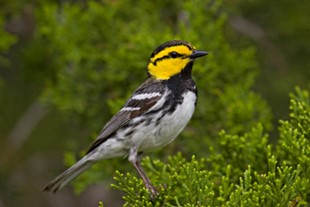
Golden-cheeked Warblers are an endangered species of songbird, which live primarily in Central Texas and similar regions; they only breed here in Central Texas and their habitats are slowly dwindling. The Balcones Canyonland Preserve (BCP), which St. Edward’s University’s Wild Basin is a part of, has over 30,000 acres of potential habitat for the Golden-cheeked Warbler. The Texas Red Oak (Quercus buckleyi) is home to a wide variety of insects, which attract the Golden-cheeked Warblers and there are deer eating a lot of the Texas Red Oak that grow in Wild Basin Nature Preserve. This is a concern, not only for the Warbler, but also for the trees themselves. The deer are damaging the mid-sized trees by stripping them of their bark and also eating up most of the new growth in the area. This is bad for the future of the trees because as the older trees die off we are unsure how many middle-aged trees or young saplings there are to fall back onto.
The area around Wild Basin is perfect for Texas Red Oak as there is just enough moisture in the soil for them to grow well. It is also a perfect place for the local deer since Texas Red Oak are a good food source because of the extreme heat that comes with being in Central Texas. Also, because of the abnormally large amount of rainfall that the Austin Area has had this spring and leading into this summer, it has changed the growth of the trees, which in turn has changed the growing season of the insects, which live in and feed off of the local trees – insects rely on temperature. Because of this, the deer are able to eat more trees, which causes the Warbler to have less material for nests and less insects for food.
This summer Dr. Bill Quinn and his group of five students from St. Edward’s University are doing research on Texas Red Oak. Dr. Quinn’s students are researching the succession of the Texas Red Oak and why the population might be at risk. I had the opportunity to accompany Dr. Quinn and his students on their initial hike of the preserve and I observed as they discussed where might be good areas for research and which trees or woody plants they might want to pay more attention to. By the end of the hike they all seemed to be set on the Texas Red Oak as their main research topic.
Dr. Quinn stated that his biggest worry is that the life cycles of the trees, insects and the Warbler will become uncoupled in the near future and that it will affect the life and breeding grounds of the Warbler in this area of Texas. His students will be setting up several areas in the preserve to study the plant growth and compare each area to help determine what exactly is happening with the trees’ succession. They will be using a program called ArcGIS to randomly select transect points within the Golden-cheeked Warbler territories.
During the hike, I learned very quickly how difficult it is to do research out in the field, and we even stayed on the trails! Even though we began hiking around eleven in the morning, it was already at least 90 degrees outside and there was not much of a breeze to cool us down. Let’s just say, I do not think that I am quite cut out for fieldwork, but I am very grateful for people like Dr. Quinn and his students who are willing to do the hard work in order to help native species. The high point of the hike was when we got to hear a Golden-cheeked Warbler singing somewhere in the trees above us. I had never heard one before and it was definitely a neat experience, despite being eaten alive by mosquitoes.
Dr. Quinn’s research is still in the beginning stages, the students are still discussing where and how they want to do the research itself, which areas and how many square meters they want to cover so that they can get the most accurate readings. The research will be completed by the end of June. Stay tuned for more on what the researchers find!
-Anna Hall, English Writing and Rhetoric Intern at Wild Basin Creative Research Center
 The Write Way TX