Over the summer semester I have had the opportunity to observe a class from St. Edward’s University which was held out here at Wild Basin. It was a Holistic Practices in Mental Health class taught by Associate Professor Vagdevi V. Meunier. I accompanied the class on a short medicinal plant hike one morning, led by a Wild Basin volunteer named Paul, and I learned about a handful of plants which can be used for helping various ailments.

The “Toothache Tree” (Zanthoxylum americanum) is a smaller shrub-like tree, with edible leaves which taste similar to Wrigley’s Juicy Fruit gum, in my opinion. These leaves have a sort of numbing effect when chewed on, hence the reason for the name. Not only can the toothache tree be used for helping tooth or mouth pain, but it can also be used to help intestinal problems. The toothache tree also has anti-bacterial, anti-fungal, anti-malarial, and anti-parasitic properties.
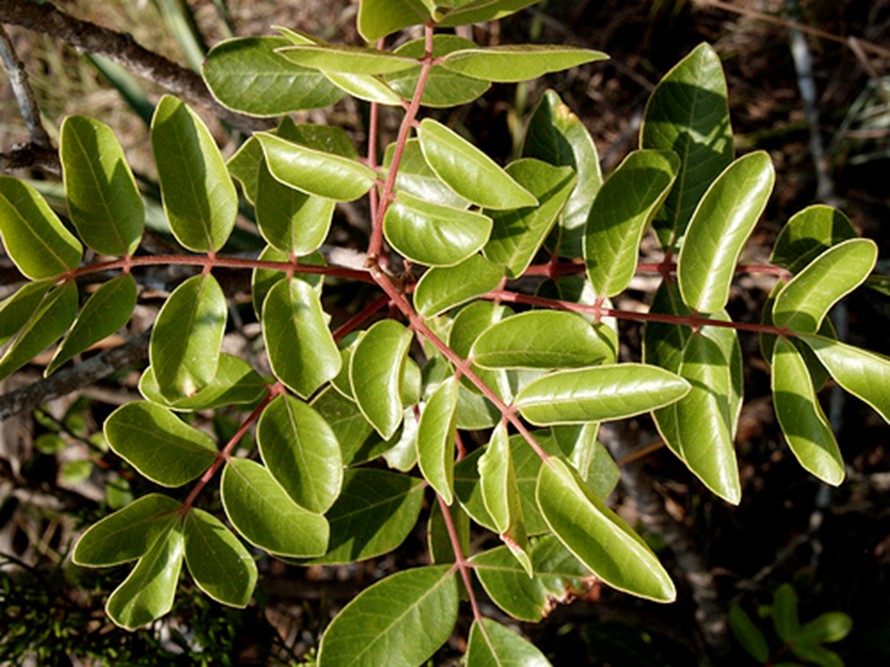
Evergreen Sumac (Rhus virens) has very tasty (but very tart!) berries and its leaves can be made into a tea of sorts to help with stomach pain among other things. Several Native American tribes used sumac to treat bladder, digestive, reproductive, and respiratory ailments, infections, injuries, stomachaches, arrow wounds, etc. Some made a decoction of sumac flowers to treat gas and indigestion while others used it as a laxative, diuretic, expectorant, liver aid, and in countless other applications.
Agarita (Berberis trifoliolata) was the last plant that Paul mentioned and he explained how the holly-like leaves on the plant help protect prey animals from their predators. He also explained the plant’s many other uses from simple things like making jelly from the berries to using the roots to help with stomach and intestinal pain or even open wounds and fever. Native American tribes used this as a laxative, to help with joint stiffness, and to help with gum and skin problems. Some tribes even used it as part of a treatment for scorpion stings.
After the medicinal plant hike, they had a guest speaker, Eileen Priya, who is a licensed homeopath. She gave a great talk on various homeopathic remedies and how they work to relieve all sorts of ailments. A lot of people seem to think that homeopathy is a scam or that it has a placebo effect, however Eileen gave several great examples of how these natural treatments have truly helped not only her, but a number of people around her. These natural ways of healing are not only for simple things like fever or stomach pain, but have also been shown to help with more complex issues such as thyroid problems or intestinal problems – problems which most doctors want to perform surgery or give prescription medication for.
On a different morning I had the wonderful opportunity to join the class again and participate in some Qi Gong (chi gong) exercises. The class had brought in a certified advanced clinical Qi Gong practitioner and acupressurist, Kay Hutchinson. Kay is an experienced Qi Gong practitioner with over 20 years of experience and has a practice nearby. Qi Gong is an ancient Chinese healing art that is over 4,000 years old and is the practice of working with, or training, the energy of the body. “Qi” means energy and “gong” translates as “cultivating” or “working with.” Thus, Qi Gong is about cultivating or training not just your body but your energy. Qi Gong trains your energy by creating a greater awareness of how energy is flowing in your body and by giving you tools to regulate or change that flow of energy in very specific ways. Qi Gong is gentle energy-healing movements that help you to regulate your life force and liberate you from mental, physical and emotional blocks. The class went through a number of breathing exercises as well as some exercises to loosen up the body, both physically and mentally. It was incredibly relaxing, very enlightening and quite easy.
Afterward, I noticed that I felt better overall. I had had upper back and shoulder pain before participating in the exercises and when the class was done, that pain was mostly gone. I also felt much lighter and felt more in tune with my body, something I had not experienced much before. This class was very eye-opening and educational for me as a simple observer and it is one of many interesting classes which are being hosted out here at Wild Basin during this summer.
-Anna Hall, Intern at Wild Basin Creative Research Center
English Writing and Rhetoric, Class of 2014
Sources:
Paul – Wild Basin Volunteer
http://www.texasbeyondhistory.net/st-plains/nature/images/agarita.html
Eileen Priya – Clear Light Healing Austin
Kay Hutchinson – http://aikihealing.com/
 The Write Way TX